Ready to automate your workflow?
Integrated cell
ARC Cell S4
An integrated cell built around the line you run, assembled on our floor and commissioned on yours.
Up to 120 kg
Payload
Per station
Grip range
< 2.5 s
Cycle time
±0.05 mm
Accuracy
.svg)
.svg)
An integrated cell built around the line you run, assembled on our floor and commissioned on yours.
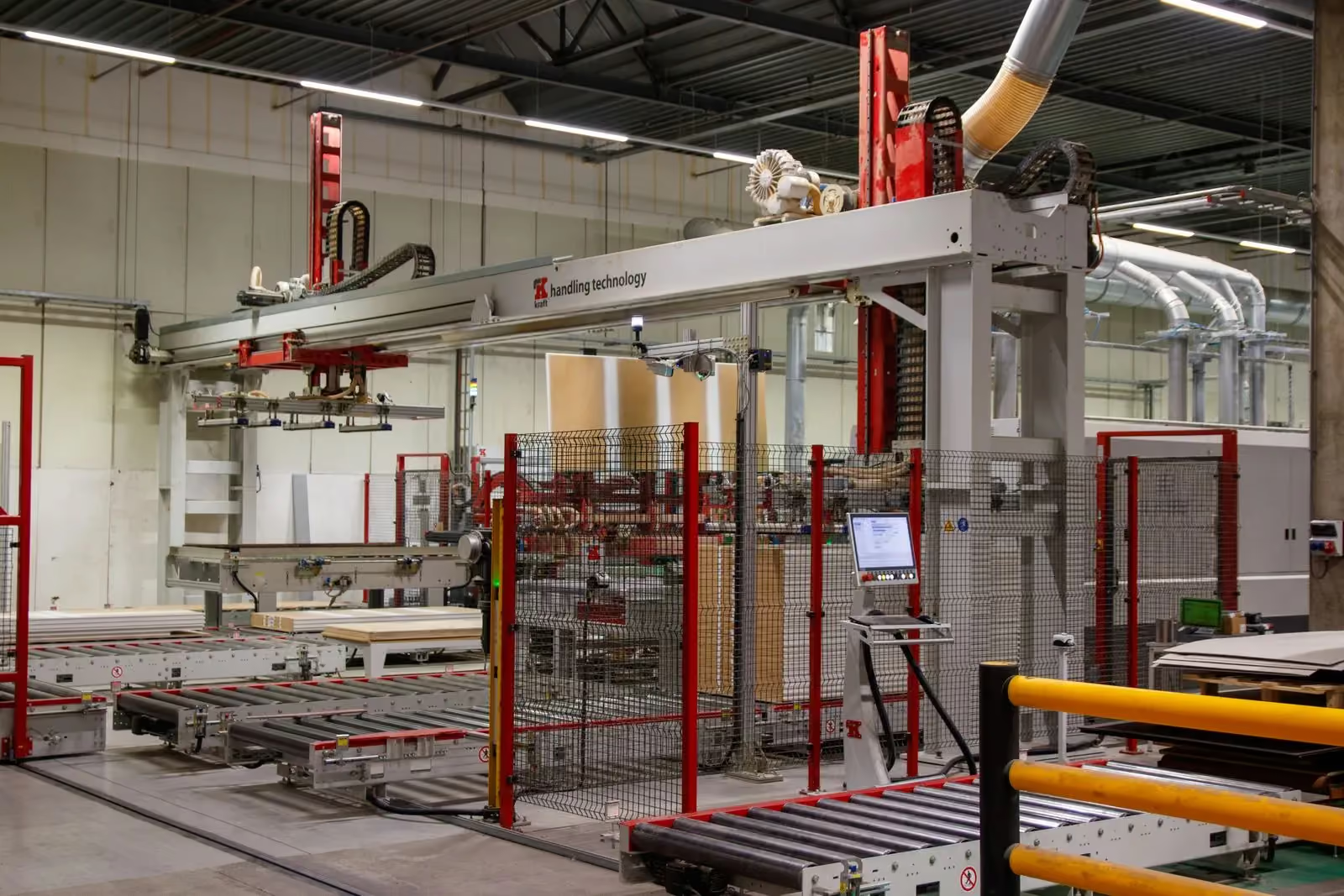
A complete work cell: robot, tooling, guarding, feeding and controls, drawn around the station it replaces. It arrives as one commissioned unit rather than a pallet of parts to assemble on your floor.
Cells suit new lines, second shifts, and stations where someone is doing work that does not need a person.
A cell is quoted against the station it replaces, not against a catalogue footprint. If the work needs two robots and a fixed fixture, that is what gets built.
.svg)

The cell carries robots up to 120 kg payload, with reach and footprint drawn against your existing floor. Cycle time is agreed before the build and verified at handover, typically under two and a half seconds per part.
Positional accuracy across the cell holds to ±0.05 mm, and that is the figure the acceptance test is run against.
Cycle time, positional accuracy, and a run of consecutive parts at production rate. It is run on your parts, on our floor, before the cell is broken down for transport — so the first time it meets your line is not the first time it has run.
Robot, PLC and safety circuits tie into the stack you already run, using your existing addressing and tag names. Guarding, interlocks and stop categories come from the risk assessment written for that cell.
Installation is planned around your production. Most cells go in across a shutdown, and the stations either side keep running.
Where the cell replaces manual work, the operator side is drawn with the people who do that work now. Reach, guard height and the loading position come out of that conversation, not a standard layout.
The handover pack holds the risk assessment, the ISO 10218 file, electrical drawings and maintenance intervals, so your engineers can open the cell without calling us.
Wear parts are standard components with published part numbers. Nothing in the cell is locked to a service contract.
The parts that would stop the cell — drive units, valves, the safety relay — are listed separately with a lead time against each. Most of them are held locally.

Product
Product
Product
Product
Product
Product
What engineers usually ask before they order a unit.
Are the drawings ours to keep?
.svg)
Will it work with the controller we already have?
Can we specify the mounting flange?
What arrives in the crate?
Do the figures on this page apply to every unit?
Can the jaws be changed for a different part?


.svg)
.svg)
.svg)
.svg)
.svg)
.svg)
.svg)