.svg)
.svg)

Ready to automate your workflow?
Almost every tooling project starts with the same question: do we hold this part with vacuum or with jaws? Most parts can be held either way. The right answer depends on three things — the surface, the weight and what happens if the part is dropped — and on being honest about each of them.
Here is how we work through that decision, in the order that usually settles it fastest.
Start with the surface
Vacuum needs a face it can seal against. Flat, smooth and non-porous parts — sheet, glass, finished panels, sealed cartons — suit it well. Cast, perforated, oily or textured surfaces leak, and a leaking cup is a cup that eventually lets go.
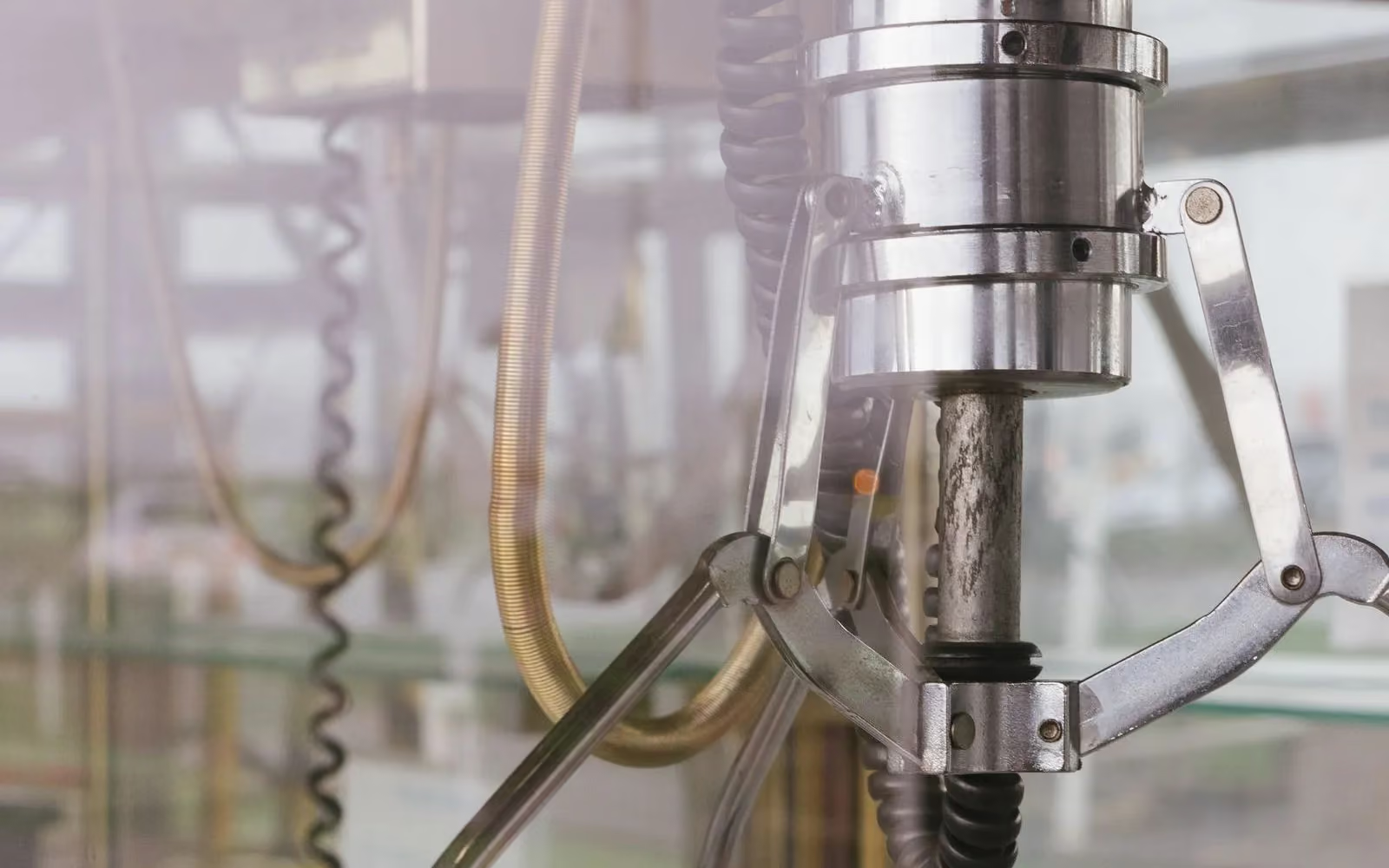
Jaws do not care about the surface, but they need somewhere to grip: two faces, a flange, an edge the part will not deform under. Thin-walled and delicate parts can still be held with jaws, but the contact faces have to be designed for them.
A quick way to decide
Most parts sort themselves out on the first two questions. Choose vacuum when:
- the part has a flat, sealed face the cup can cover;
- it is light for its area and moved at moderate speed;
- the face must not be marked by jaws.
Choose jaws when:
- the surface is porous, oily, textured or perforated;
- the part is heavy for its size or moved fast;
- a dropped part would damage the line or injure someone.
Where a part meets conditions from both lists, the next two sections usually settle it.
Then the weight and the motion
A cup holds by the area it covers and the vacuum level behind it. Heavy parts moved quickly need more area than the part has, or a vacuum level the pump cannot keep up. Acceleration matters as much as weight: a part that is easy to lift can still peel off a cup when the arm changes direction.
Jaws hold by force and friction, and scale more predictably with payload. Doubling the part weight usually means a larger cylinder, not a different principle.
Decide what a drop costs
Loss of air releases a vacuum part almost at once. A jaw gripper can be specified to hold on loss of pressure, keeping the part until the station is safe.
Where a dropped part damages the line or the person beside it, that settles the question before anything else does.
Sometimes both
Some of our tools carry cups for the face and jaws for the edge. The cups take the part cleanly off a stack; the jaws take over the load for the fast move. It costs more to build and less to run than a line that stops for every dropped part.
Final thoughts
Look at the surface first, then the weight and the motion, then the cost of a drop. Most decisions are made by the first question and confirmed by the other two. When they disagree, the cost of a drop wins.


.svg)
.svg)
.svg)
.svg)
.svg)
.svg)
.svg)