.svg)
.svg)
Ready to automate your workflow?
A line that only ever runs one part is increasingly rare. Most of the stations we build handle a family of parts — different sizes, different finishes, sometimes different materials — and they switch between them several times a week or several times a shift.
Every switch is a changeover, and every changeover is time the station is not making parts. The goal is simple to state and harder to design for: a changeover that fits inside a shift break.
Treat the changeover as a cycle
A line that runs four part numbers does not have one cycle time. It has four, plus the time between them. If the changeover takes an hour, that hour is part of the spec, and it belongs in the calculation of what the station can produce in a week.
So we ask for the changeover target at the same time as the cycle time, and design for both from the start.
Change the faces, not the tool
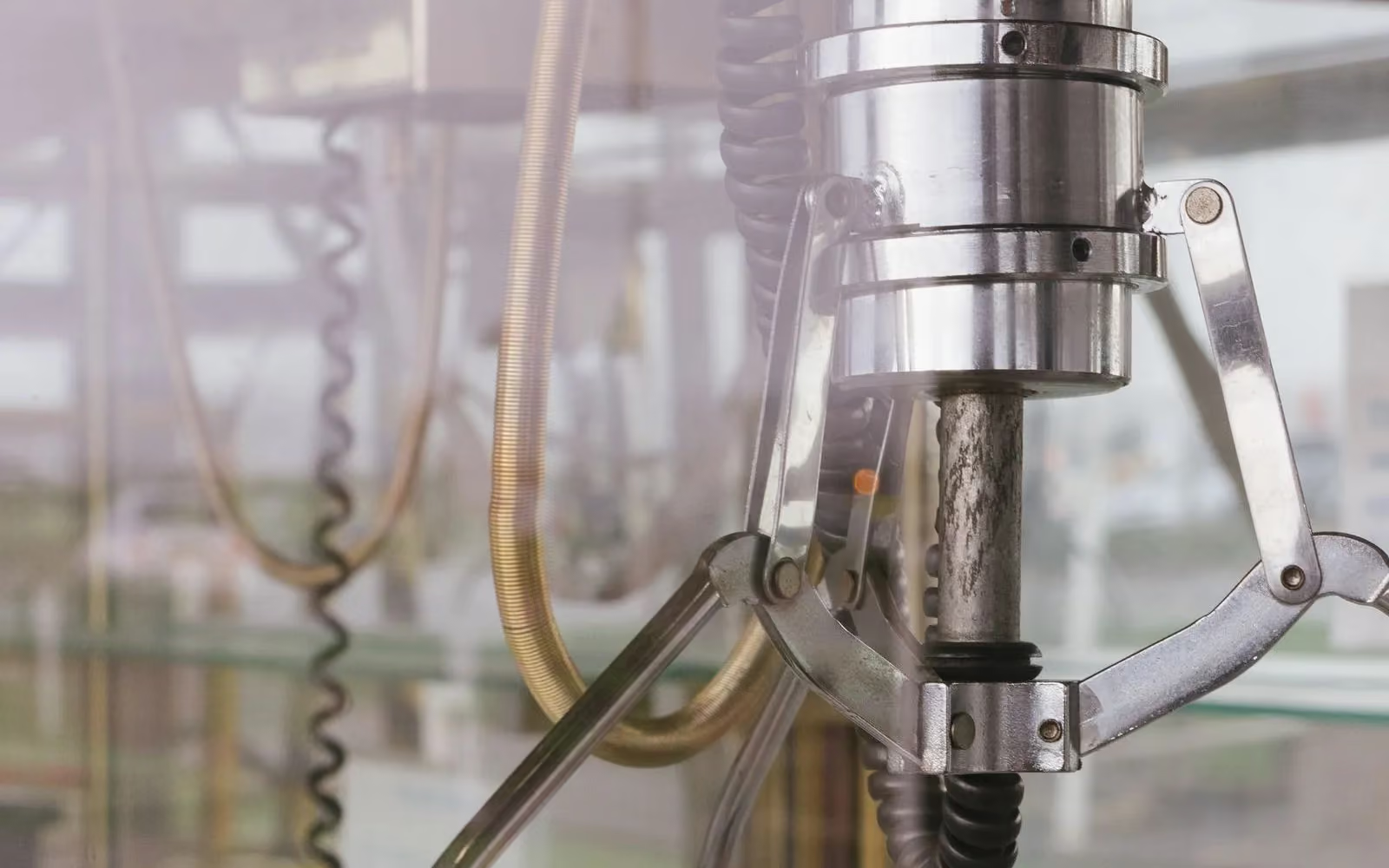
Where the parts are related, the gripper body stays and only the contact faces change. Keyed locations mean a face can only go on one way, and a tool change becomes a two-minute job for whoever is on shift.
Where the parts are too different for shared faces, a quick-change coupling at the wrist swaps the whole tool instead. It costs more, but it still keeps the change inside minutes rather than hours.
What a changeover looks like on the floor
On a station built this way, the sequence is short enough to learn in one demonstration:
- the line calls the next part number and the station finishes its last cycle;
- the operator releases two quick-change pins and lifts the faces off;
- the new faces go on their keyed locations — they only fit one way;
- the station loads the recipe for the new part and runs a single check cycle;
- production resumes.
If a changeover needs the person who designed the tool, it will not fit inside a break.
Every part gets a recipe
Grip force, approach and release are stored per part and called up by the line, not typed in at the teach pendant. The recipe is proven on our bench for every part before the tooling ships, so the first time a part runs on your floor is not the first time it has run.
Recipes also remove the most common changeover fault: the right faces with the wrong settings.
Store the faces where they are used
Faces kept in a cabinet across the hall add a walk to every changeover. We supply a labelled rack beside the station, one slot per part number, so the next set is always within reach and a missing set is obvious.
Measure it on the floor
At commissioning we time a full changeover with your operators, not ours. If it does not fit inside the break, we change the design rather than the break.
Final thoughts
Design the changeover alongside the cycle, change faces rather than tools, store a recipe for every part and keep the faces beside the station. A changeover built that way stops being downtime and becomes part of the routine.


.svg)
.svg)
.svg)
.svg)
.svg)
.svg)
.svg)